Horizontal Directional Drilling (HDD) allows contractors to install underground utilities while minimizing disruption to roads, pavement, landscaping, and other surface features. But because the installation takes place underground, careful planning is essential before the drill ever enters the ground.
One of the risks contractors need to consider is a cross bore.
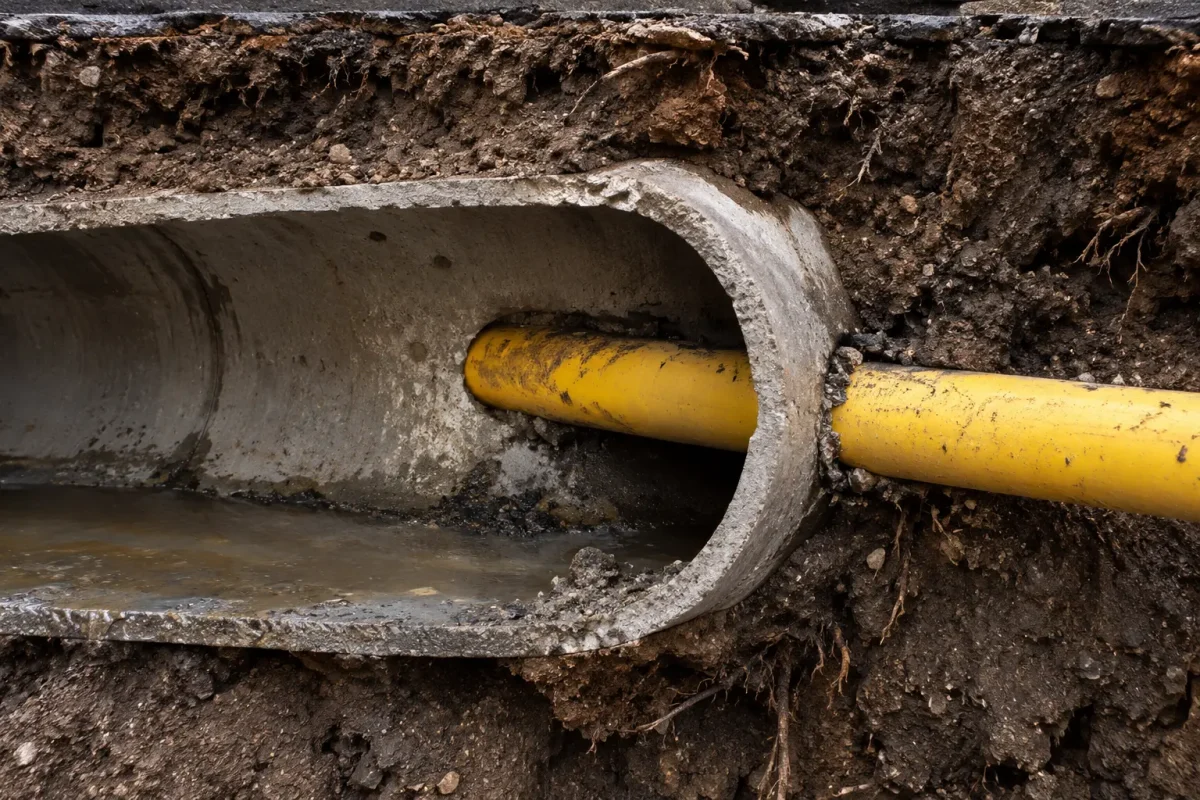
A cross bore occurs when a newly installed underground utility or structure intersects an existing underground utility or structure. One of the most concerning examples is when a new gas line installed using trenchless technology crosses through an existing sewer line or sewer lateral. The problem may remain hidden until someone later attempts to clear the sewer with mechanical equipment.
For directional drilling contractors, this highlights an important point: locating the obvious utilities isn’t always enough.
Sewer laterals and other private or non-metallic underground facilities may not appear in standard utility records or conventional locating systems. A planned bore can therefore encounter an underground structure that wasn’t identified during initial utility coordination.
This is why cross bore inspection and subsurface investigation should be considered during HDD planning, particularly in developed areas with existing sewer infrastructure.
What Is a Cross Bore?
A cross bore occurs when one underground utility or structure passes through another underground utility or structure.
For example, imagine a contractor is installing a new underground gas or utility line using HDD.
The planned bore path crosses an existing sewer lateral that isn’t shown on the available plans.
If the drilling operation passes through the sewer lateral, the two utilities can become physically intertwined.
From the surface, the problem may not be visible.
The installation may appear complete and operational, while the cross bore remains hidden underground.
The risk can become more serious later if someone performs maintenance on the sewer.
PHMSA explains that a gas line crossing a sewer can be damaged when mechanical equipment such as a rotating auger is used to clear a blockage. If the gas line is damaged, gas can potentially migrate through the sewer into a building.
Cross bores are therefore not simply a construction-quality issue. In certain circumstances, they can become a serious public safety concern.
Why Can Cross Bores Be Difficult to Identify?
One of the biggest challenges is that not every underground utility is easy to locate.
Many conventional utility locating systems work particularly well with conductive utilities. However, sewer laterals are frequently made from non-metallic materials and may not be detectable using conventional electromagnetic locating methods.
PHMSA notes that sewer laterals are often not shown on maps and are commonly non-metallic, making them difficult to locate using conventional methods.
This creates a potential blind spot for HDD projects.
A contractor may have:
- Completed the required utility notification
- Reviewed available plans
- Located marked utilities
- Confirmed the proposed bore path
…and still have an unidentified sewer lateral crossing the route.
That is why cross bore risk needs to be considered separately from simply checking whether marked utilities are present.
Why Is Cross Bore Inspection Important Before HDD?
HDD is designed to reduce surface disruption, but the drilling operation still interacts directly with the underground environment.
Once the pilot bore begins, the drill head follows a predetermined path beneath the surface.
If an unidentified underground structure is located along that path, the drilling operation may create a conflict before the crew realizes what happened.
A cross bore inspection can help identify potential conflicts before drilling begins.
The goal is to develop a better understanding of the underground environment and determine whether existing sewer infrastructure or other buried structures could intersect the proposed bore.
This is especially important when:
- Working in developed neighborhoods
- Installing utilities along established roadways
- Working near existing sewer systems
- Installing gas infrastructure
- Drilling through utility easements
- Working in areas with incomplete utility records
- Installing long or complex bore paths
811 Locates Are Important—but They May Not Be Enough
One of the most important distinctions contractors should understand is the difference between 811 utility notification and a comprehensive subsurface investigation.
In Florida, contractors are required to notify Sunshine 811 at least two full business days before covered excavation or demolition work begins. Sunshine 811 then notifies participating utility operators so they can locate and mark their facilities.
This is an essential part of safe digging.
However, 811 markings don’t necessarily represent every underground feature on a property.
Sunshine 811 explains that private underground facilities are common and are not included in its database. Examples can include private water lines, irrigation systems, fire mains, parking lot lighting, and building-to-building utilities.
Sewer laterals can present a similar challenge.
If a sewer lateral isn’t owned or marked by a participating utility operator, it may not be identified through a standard locate.
For HDD contractors, this means:
An 811 ticket should be part of the process—not necessarily the entire process.
How Can Contractors Identify Potential Sewer Conflicts?
There isn’t one universal method that works for every site.
A comprehensive investigation may combine several sources of information and technologies.
Review Existing Utility Records
Start with whatever documentation is available.
This may include:
- Civil drawings
- Utility plans
- As-built drawings
- Sewer maps
- Site plans
- Previous construction records
- Property information
Plans can provide useful information about the expected location of underground infrastructure.
However, contractors should recognize that records may not always reflect actual field conditions, particularly on older properties.
Contact the Appropriate Utility or Sewer Owner
Where applicable, coordinate with the municipality, utility owner, or wastewater system operator.
They may have information about sewer mains, laterals, manholes, cleanouts, or other infrastructure.
Perform Surface Investigation
Visible features can provide clues about underground systems.
Look for:
- Manholes
- Sewer cleanouts
- Utility markers
- Valve boxes
- Drainage structures
- Service connections
- Evidence of previous construction
These features can help technicians understand how underground systems may be configured.
Use GPR Where Appropriate
Ground Penetrating Radar (GPR) can provide additional subsurface information.
GPR sends electromagnetic signals into the ground and records reflections caused by changes in underground materials.
Depending on site conditions, it can help identify potential:
- Pipes
- Conduits
- Buried structures
- Voids
- Utility crossings
- Other subsurface anomalies
GPR can be particularly useful when conventional locating methods don’t provide enough information about non-metallic or undocumented infrastructure.
However, GPR does not automatically identify every sewer lateral. Soil composition, moisture, depth, pipe size, and other conditions can affect detection.
The results also require professional interpretation.
When Should a Cross Bore Inspection Be Considered?
Cross bore investigation is particularly important when the planned HDD route passes through developed areas where existing sewer infrastructure is likely.
Consider additional investigation when:
The Project Involves Gas Infrastructure
The potential consequences of a gas line crossing an existing sewer are particularly serious.
PHMSA identifies cross bores involving gas distribution lines and sewer systems as a known damage-prevention concern.
Sewer Laterals Are Not Clearly Mapped
If available records don’t show the location of sewer laterals, additional investigation may be appropriate.
The Bore Runs Through Established Neighborhoods
Older residential areas can contain decades of underground infrastructure and modifications.
Utility Records Are Incomplete
If drawings are missing, outdated, or inconsistent with field conditions, the project has greater uncertainty.
The Bore Is Close to Existing Sewer Infrastructure
Even if the sewer main is known, laterals branching from the main may still need to be considered.
The Project Has a Complex Bore Profile
Longer or deeper bores crossing multiple utility corridors can increase the number of potential conflicts that need to be evaluated.
How Cross Bore Risk Can Affect HDD Planning
A potential cross bore doesn’t necessarily mean a project can’t use HDD.
Instead, the information can be incorporated into the bore planning process.
Depending on the findings, the contractor may need to:
- Adjust the bore alignment
- Change the bore depth
- Modify entry or exit locations
- Increase separation from existing utilities
- Physically verify a critical crossing
- Use an alternative installation method
- Coordinate with the utility owner
- Add additional monitoring or inspection
The earlier a conflict is identified, the more options the project team generally has.
Discovering a potential conflict after drilling has started can be much more difficult and disruptive.
What About Cross Bores That Already Exist?
Cross bore inspection isn’t only relevant to new HDD projects.
Existing cross bores can remain underground for years without being noticed.
PHMSA notes that a cross bore can go undetected for months or years and may only become apparent later when maintenance is performed on the sewer.
This is one reason sewer inspection programs can be important for identifying legacy cross bores.
For example, if a sewer lateral becomes blocked and a plumber uses mechanical equipment to clear it, an unidentified gas line inside the sewer could potentially be damaged.
Sunshine 811 specifically warns plumbers and sewer-cleaning professionals about this risk and recommends using minimally invasive methods and a camera when the cause of an obstruction cannot be determined.
This demonstrates why cross bore awareness isn’t only an HDD contractor issue.
It involves the entire underground utility lifecycle—from installation to maintenance.
How AM Utility Contractors Can Help With Pre-HDD Utility Investigation
Before an HDD project begins, contractors need more than a proposed alignment on a drawing. They need a reasonable understanding of what exists beneath that alignment.
At AM Utility Contractors, we provide GPR utility scanning, cross bore inspection, and horizontal directional drilling services to support underground infrastructure projects throughout South Florida.
Our GPR utility scanning services can help investigate subsurface conditions and identify potential underground features that may affect a planned bore. Our cross bore inspection services can also help identify potential conflicts between existing underground utilities and sewer laterals or other subsurface infrastructure—an important consideration when planning trenchless work.
When appropriate, this information can be incorporated into the broader HDD planning process alongside utility records, 811 information, other locating methods, and physical verification.
Cross bore prevention requires a project-specific approach. GPR and cross bore inspection are not guarantees that every underground feature will be detected, and no single locating method should automatically be treated as a complete map of the subsurface.
The goal is to reduce uncertainty, identify potential conflicts, and give the project team better information before drilling begins.
If you’re planning an HDD project in South Florida and need help with GPR utility scanning, cross bore inspection, or pre-drilling utility investigation, contact AM Utility Contractors to discuss your project and request a quote.
Frequently Asked Questions
What is a cross bore in HDD?
A cross bore occurs when a newly installed underground utility intersects an existing underground utility or structure. A common example is a gas line installed using HDD that passes through an existing sewer line or lateral. The intersection may remain hidden until the existing utility is later serviced or repaired.
Does 811 locate sewer laterals before HDD?
Not necessarily. Sunshine 811 coordinates the marking of facilities owned and maintained by participating utility operators, but private facilities and certain sewer laterals may not be included in the standard locate process. Additional investigation may therefore be necessary depending on the project and site conditions.
How can contractors reduce cross bore risks before directional drilling?
Contractors can reduce risk by reviewing available utility and sewer records, completing the required 811 notification, investigating private utilities, considering GPR scanning, using CCTV inspection where appropriate, physically verifying critical crossings, and incorporating the findings into the final bore plan. The appropriate investigation depends on the project and existing underground conditions.