Broward County is home to a growing network of roads, businesses, residential communities, commercial developments, telecommunications systems, and public infrastructure. As new construction and redevelopment projects continue to expand, contractors are increasingly working around complex underground utility networks.
Water lines, sewer systems, storm drainage, electrical conduits, telecommunications infrastructure, and other buried utilities all have to share limited space beneath the surface.
That makes underground utility construction in Broward County a project that requires more than simply excavating a trench and installing a pipe.
Before construction begins, contractors need to understand what utilities are already present, who has jurisdiction over the work area, what permits may be required, and how the installation will affect surrounding infrastructure.
Broward County also has an extensive network of public and private roads, easements, and rights-of-way. Depending on where a project is located, contractors may need to coordinate with Broward County, a municipality, a utility provider, or another agency with jurisdiction over the property or right-of-way. Broward County’s Highway Construction and Engineering Division handles engineering plan review, permitting, and roadway inspection for improvements on Trafficway roads and functionally classified County roads.
So, what should contractors know before starting an underground utility project in Broward County?
Why Is Underground Utility Construction Challenging in Broward County?
One of the biggest challenges is that the underground environment is rarely as simple as construction drawings make it appear.
A project site may contain utilities installed years or even decades ago. Some may have been relocated, repaired, extended, or abandoned. Older utility records may not perfectly reflect current field conditions.
At the same time, new construction often needs to fit within existing corridors without disrupting active services.
Contractors may encounter:
- Water distribution lines
- Sanitary sewer systems
- Stormwater drainage
- Electrical conduits
- Gas lines
- Telecommunications and fiber optic cables
- Irrigation systems
- Fire protection lines
- Private utility infrastructure
- Abandoned or undocumented utilities
The challenge becomes even greater when working in developed areas where there is limited space for new infrastructure.
This is why careful planning and utility investigation should happen before excavation begins.
What Types of Underground Utility Projects Are Common?
Underground utility construction covers a wide range of projects.
Depending on the development and site requirements, contractors may be involved with:
Water Line Installation
New developments, commercial properties, and infrastructure improvements may require new water distribution lines or extensions to existing systems.
These projects can involve installing new mains, service connections, valves, fittings, and related infrastructure.
Sewer Installation
Sanitary sewer systems are another major component of underground construction.
Contractors may install gravity sewer lines, force mains, manholes, lift station infrastructure, and service connections depending on the project.
Stormwater Infrastructure
Florida’s heavy rainfall makes effective stormwater management particularly important.
Underground drainage systems can include:
- Storm sewer pipes
- Inlets
- Catch basins
- Drainage structures
- Culverts
- Underground retention or detention systems
Telecommunications Infrastructure
The demand for reliable connectivity continues to drive installation of underground telecommunications infrastructure.
Fiber optic cables and communication conduits may need to cross roads, parking lots, sidewalks, and developed properties.
Electrical Infrastructure
Underground electrical conduits can be installed for commercial developments, residential communities, infrastructure upgrades, and other construction projects.
The specific requirements depend on the utility owner and project design.
What Should Contractors Know About Broward County Permits?
Permitting is one of the first things contractors should address during project planning.
If the work is taking place within a Broward County-controlled public right-of-way, county permitting requirements may apply.
Broward County provides applications for construction in the public right-of-way, including utility-related work. The County also provides paving and drainage plan review applications for water and sewer permits, road construction permits, and sidewalk permits involving public road rights-of-way under County jurisdiction.
Broward County’s minimum construction standards also state that new underground facilities in existing or proposed County rights-of-way generally require a permit from the Highway Construction and Engineering Division, subject to specified exceptions.
However, not every road or property in Broward County falls under County jurisdiction.
A project could instead involve:
- A city right-of-way
- A private road
- A state-maintained roadway
- A utility-owned corridor
- A private easement
- Unincorporated Broward County
The applicable permitting authority can therefore vary depending on the exact project location.
Contractors should confirm jurisdiction before assuming that a County permit is the only approval required.
Why Is Utility Locating Important Before Excavation?
One of the most important steps in underground construction is determining where existing utilities are located.
Florida’s underground facility damage prevention requirements require excavators to notify Sunshine 811 at least two full business days before beginning covered excavation or demolition work, with different requirements for work beneath state waters. Florida law also specifically includes directional drilling and other trenchless technologies within the definition of excavation.
Sunshine 811 coordinates notifications with member utility operators, but it is important to understand what that process does—and doesn’t—do.
Sunshine 811 itself does not locate underground utilities. Member utility companies or their locators are responsible for locating and marking their facilities.
There is another important consideration: private utilities.
Public utility locates may not cover privately owned infrastructure such as irrigation systems, private water lines, landscape lighting, fire mains, building-to-building utilities, or other facilities on commercial properties. Sunshine 811 specifically recommends considering a private locator when private facilities could conflict with excavation.
For contractors, this means an 811 ticket should be considered an essential part of the process—not necessarily the entire utility investigation.
When Should Contractors Consider GPR Utility Scanning?
Ground Penetrating Radar (GPR) can provide another layer of information when existing utility records and standard locating methods aren’t enough.
GPR uses radar signals to identify changes in subsurface materials and can help locate both metallic and non-metallic underground features.
This can be particularly useful when working around:
- PVC pipes
- Concrete utilities
- Electrical conduits
- Telecommunications infrastructure
- Water lines
- Sewer systems
- Unknown subsurface structures
- Congested utility corridors
GPR can also be valuable before directional drilling.
A planned bore path may look clear on a drawing while containing undocumented utilities or other underground obstacles.
Combining utility locating with GPR scanning can give contractors a more complete picture of the subsurface before excavation or drilling begins.
AM Utility Contractors provides GPR utility scanning designed to help identify underground utilities and subsurface features before construction and excavation activities.
Why Are Private Utilities a Concern on Commercial Projects?
Commercial properties often have more underground infrastructure than contractors initially realize.
For example, a shopping center, school, industrial facility, or large commercial property may have privately owned:
- Fire mains
- Irrigation lines
- Parking lot lighting
- Communication lines
- Water lines
- Sewer connections
- Building-to-building utilities
These may not be included in standard 811 markings.
A contractor who assumes that every underground line will be marked through the public utility locating process could therefore encounter an unexpected utility during excavation.
Before breaking ground, review available site plans and investigate the property for signs of private infrastructure.
If necessary, use private utility locating services to identify facilities that fall outside the public 811 system.
What Is the Tolerance Zone in Florida?
Utility marks should never be treated as an exact line that can be safely excavated directly alongside with heavy equipment.
Florida’s underground facility damage prevention requirements establish a 24-inch tolerance zone from the outside edges of a marked underground facility. When excavation takes place within this zone, increased precautions are required. These can include hand digging, potholing, soft digging, vacuum excavation, or similar methods. Mechanized equipment used within the tolerance zone must be supervised.
This is particularly important on crowded Broward County construction sites.
When multiple utilities are located close together, contractors may need to expose utilities through controlled excavation before continuing with larger-scale work.
Vacuum excavation or potholing can help physically verify the location and depth of a utility before heavy excavation proceeds.
What About Directional Drilling in Broward County?
Not every underground installation needs to be completed using traditional open trench excavation.
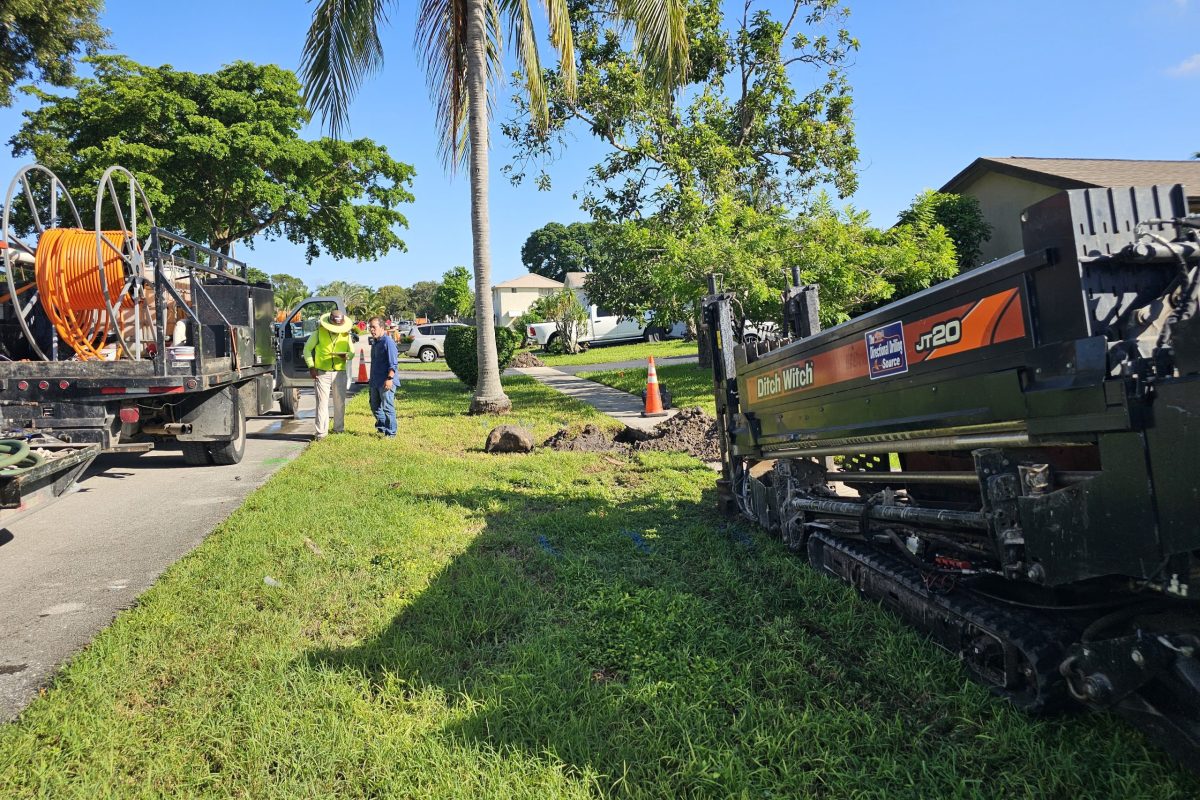
Horizontal Directional Drilling (HDD) can be a practical option when contractors need to install utilities beneath obstacles while minimizing surface disruption.
HDD can be used for projects involving:
- Telecommunications
- Fiber optic conduit
- Water lines
- Sewer force mains
- Electrical conduit
- Other underground utilities
It can be especially useful when an installation needs to pass beneath:
- Roads
- Parking lots
- Landscaped areas
- Driveways
- Waterways
- Other surface obstacles
However, directional drilling does not eliminate the need for utility locating.
In fact, understanding the existing underground environment is particularly important before drilling because the bore travels beneath the surface and can cross existing infrastructure that isn’t visible from above. Think you need HDD? Prepare for possible costs as early as today by reading our simple guide.
AM Utility Contractors provides horizontal directional drilling services for applications including telecommunications, utility installation, roadway projects, residential development, and industrial projects.
How Should Contractors Plan Around Existing Rights-of-Way?
Right-of-way coordination should be addressed early rather than after construction plans are finalized.
Before beginning work, contractors and project teams should determine:
- Who owns the right-of-way?
- Which agency has jurisdiction?
- Are there existing easements?
- Are utility corridors already established?
- Are there roadway or traffic restrictions?
- What permits are required?
- Are restoration requirements applicable?
- Are other utility owners involved?
Broward County maintains records related to rights-of-way and easements, and its Engineering Division coordinates right-of-way and construction requirements for applicable projects.
For projects involving County water and wastewater systems, additional utility connection and development coordination requirements may apply. Broward County Water and Wastewater Services provides standards and processes for projects involving its potable water, wastewater, and reclaimed water systems.
Getting these details clarified early can help prevent redesigns and construction delays.
What Can Cause Underground Utility Projects to Go Over Budget?
Underground construction is inherently difficult to price when the subsurface conditions are uncertain.
Unexpected costs can come from:
- Unmarked utilities
- Incorrect utility records
- Poor soil conditions
- Groundwater
- Rock or other obstructions
- Utility conflicts
- Permit delays
- Restricted site access
- Traffic control requirements
- Restoration work
- Design changes
- Unexpected depth requirements
- Additional potholing or utility verification
This is why investing in pre-construction investigation can be much less expensive than discovering an underground conflict after construction has already started.
A detailed utility investigation can help identify potential conflicts before crews, equipment, and materials are committed to the installation.
What Should Contractors Do Before Starting an Underground Utility Project?
A well-planned project starts with understanding the site.
Before excavation begins, contractors should consider the following:
1. Confirm the Project Scope
Know exactly what utilities are being installed, where they will run, their approximate depth, and where they connect to existing infrastructure.
2. Confirm Jurisdiction
Determine whether the work falls under Broward County, a municipality, FDOT, a utility provider, or another authority.
3. Obtain Required Permits
Review applicable permitting and plan requirements before mobilizing equipment.
4. Submit the 811 Notification
Contact Sunshine 811 at least two full business days before covered excavation work begins and allow the required utility operators to respond.
5. Review Utility Responses
Don’t simply assume that an 811 ticket means the site is ready to dig.
Sunshine 811 recommends confirming the positive response codes from member utilities and comparing those responses with the actual marks visible at the job site. If something doesn’t match, contact the appropriate utility operator before digging.
6. Investigate Private Utilities
Determine whether private infrastructure exists within the work area and arrange additional locating when necessary.
7. Consider GPR or Other Detection Methods
For congested, uncertain, or high-risk areas, additional subsurface investigation can provide valuable information before excavation.
8. Plan the Installation Method
Determine whether traditional excavation, directional drilling, or another installation method makes the most sense for the site.
9. Plan for Restoration
Consider how roads, sidewalks, landscaping, pavement, and other surfaces will be restored after construction.
Why Work With an Experienced Underground Utility Contractor?
Underground utility construction requires coordination between engineering, locating, excavation, installation, equipment, safety, and permitting.
An experienced contractor understands that the installation itself is only one part of the project.
The goal is to complete the work without damaging existing infrastructure, creating unnecessary disruption, or discovering avoidable problems after construction has begun.
This is especially important in a developed area like Broward County, where underground space can be crowded and project sites frequently interact with existing roads, businesses, homes, and public infrastructure.
At AM Utility Contractors, we provide underground utility and excavation solutions designed around the specific needs of each project. Our services include GPR utility scanning and horizontal directional drilling, helping contractors and project teams investigate subsurface conditions and complete underground installations while minimizing unnecessary surface disruption.
Whether you’re preparing for a new development, telecommunications installation, utility upgrade, directional drilling project, or other underground construction work, proper planning can make a significant difference in project safety, efficiency, and cost control.
If you’re planning an underground utility project in Broward County or elsewhere in South Florida, contact AM Utility Contractors to discuss your project and request a quote.
Frequently Asked Questions
Do I need an 811 locate before underground utility construction in Broward County?
Yes. Florida law requires excavators to notify Sunshine 811 at least two full business days before covered excavation or demolition work begins. The requirements also apply to directional drilling and other trenchless excavation methods.
Does an 811 locate identify every underground utility on a Broward County construction site?
No. Sunshine 811 coordinates the locating of member utility facilities, but privately owned utilities may not be included. Private infrastructure such as irrigation, fire mains, private water lines, and building-to-building utilities may require additional investigation by a private locator.
When should contractors use GPR for underground utility construction?
GPR can be especially useful when utility records are incomplete, non-metallic utilities may be present, the site is congested, or additional subsurface information is needed before excavation or directional drilling. It can provide another layer of information alongside 811 markings and other utility locating methods.